Why do smart people fall for crypto scams?
People get scammed in crypto because they want a lot of money quickly without doing the work. Here's how every crypto scam works, why smart people fall for it, and the three-question audit that stops the second one.

Updated

People get scammed in crypto because they want a lot of money, really quickly, without doing any of the work. That's the whole engine, and everything else is just a costume.
A crypto scam is any scheme that takes your money or your crypto by promising a return it can never deliver, and it works by hitting one of three emotions: greed, fear of missing out, or love. The mechanism changes every few months. The emotion never does.
Now, I've been in crypto since 2013, and people have been coming to me for advice on it for a decade. I've audited more of these with the folks caught in them than I could ever count. So this is the page I wish every one of them had read first, and it's also the first lesson in our Scam Vault, because until you understand why this works on people, you're going to keep believing it can't work on you.
So who's this for? It's for the person who's willing to look at their own wiring before they look at the scammer's. And if you're here to confirm that the people who get scammed are dumber than you... I'm about to make you a little uncomfortable, and I'm fine with that.
What's in the video: why capital preservation is the whole game, the two mindset shifts that put people in front of a scam, why the overwhelming majority of people in crypto never make a dollar, and the duck test.
What is a crypto scam, in plain words?
Somebody shows you a number on a screen and tells you it's yours.
That's the definition that covers all of them. The fake trading platform shows you a dashboard, the romance scam shows you a boyfriend's "portfolio," the WhatsApp group shows you screenshots, and the Coinbase text shows you a withdrawal you didn't make. But in every case, the number is typed by the person who's about to take your money, and your only "control" is a login they handed you.
So a crypto scam is not a bad investment. A bad investment can lose, but a scam was never an investment at all. The money went to a wallet somebody else holds the moment you sent it, and nothing was ever bought on your behalf. That's why the first small withdrawal works and the big one never does.
How does a crypto scam work, every single time?
Four beats. Learn them once and you'll see them everywhere.
- The promise. A return that's big, fast and certain. Two percent a day. A balance that doubles by Friday. "My uncle's friend trades for a hedge fund."
- The trust. Weeks of chatting, a professional-looking site, a hold message and a case number, or a profile with your favorite trader's face on it. The trust is manufactured, and it's manufactured by people who do this for a living.
- The small win. You put in $5,000 and they let you take out $800. So now it's real, right? That $800 was the cheapest marketing a fraud ever buys.
- The squeeze. You go to withdraw and there's a tax. Then a fee. Then a verification deposit. Then the account is "under review." And every dollar you send to unlock your money is just more money gone, until you stop or you run out.
Then four or five weeks later the recovery agent calls. Same operation, different phone.
And here's the thing about those four beats. None of them require you to be stupid. They just require you to want something badly enough to stop checking.
Why do smart people get scammed in crypto?
Because of two mindset shifts that happen before the scammer ever shows up.
Most folks' first step into crypto is an emotional one. They don't understand it yet, but they see people online claiming big results and they want in on it. Fine. Everybody wants in on it. The problem is the second shift: they want it really quickly, with only a little bit of money, and without putting in any time, energy or skill. A thousand dollars in, a fortune out, by summer, without learning a thing.
Now that combination is exactly what the scammer is hunting for. Not stupidity... appetite without skill. Because the person who wants the returns and doesn't know how to earn them goes looking for somebody who'll do it for them, and the person who shows up to do it for them is the scam.
I watched it happen to a commercial real estate broker with a whole portfolio of investment properties, back in 2017, with a platform I told him was a fraud before he ever sent a dollar. He sent roughly $35,000 anyway and wrote it off for years. Respectable people. Successful people. The appetite doesn't check your résumé.
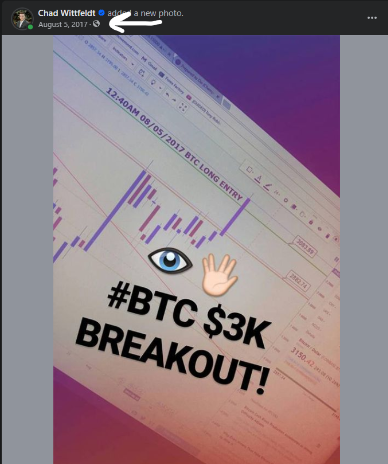
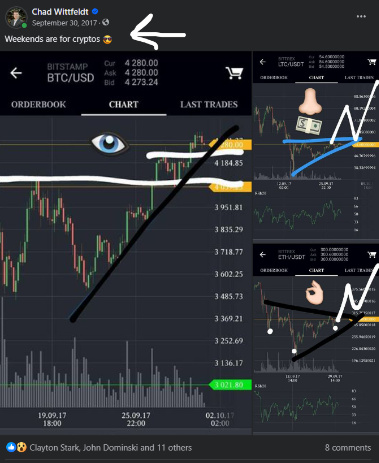
And so you know that's not hindsight talking, here's what I was posting publicly that same year: the $3,000 bitcoin breakout call in August 2017, and a bitcoin chart I posted a few months later.
August 2017: the $3K breakout call
Later in 2017: the chart post
Which emotion gets you: greed, FOMO or romance?
When I audit a scam with somebody, the first question is always the same. Which one got you?
Greed. The fixed daily return, the compounding dashboard, the signal group that "never loses." Greed is the one people admit to last, and it's the most common by far.
FOMO. The group where everybody else is already making money, the window that closes tonight, the coin that's "about to list." Fear of missing out is what makes you skip the ten minutes of research that would have saved you.
Romance. Eight or nine months of texting with someone who was never real, and then "my aunt knows a trader." Romance is the slowest and the most expensive. The longest case I've seen ran most of a year and cost an acquaintance of mine about $322,000.
So name the emotion, and the scam loses half its power, because now you know what it was aiming at. You can't be in the driver's seat and asleep at the wheel at the same time.
How good are these people, really?
Better than you think, and I say that as somebody who's called them on camera.
The mechanism is only half the scam. The social engineering on the other end is the other half, and these people are really good at it. When I called the number on a Coinbase scam text and recorded it, they ran me for 25 minutes before asking for anything. A hold message, a recorded-line notice, two "advisors," and questions a compliance desk would ask. The guy even told me he used to do credit cards. So this is a career with a script, a manager and quotas, and the script was written by people who understand panic, authority and patience better than most salespeople you've ever met.
So no, you weren't an idiot. You were a target of professionals. That's a different thing, and it has a different fix.
How do you make sure it never happens again?
Two tools, common sense and Google. And I know how that sounds.
The duck test. If it walks like a duck, quacks like a duck and swims like a duck, it's probably a duck. You don't need to go investigate every "opportunity" with your own money to know what it is. If it has a fixed or certain return, a platform you're required to use, a WhatsApp or Telegram account manager, and a leader with a nickname instead of a name... you already know. Four questions, ten minutes, and they're on how to spot a crypto scam.
The audit. If it already happened, sit with it for one day and answer three things in writing. Which emotion got you? Which red flags can you see now that you couldn't see then? And why did you hold on as long as you did? That's not punishment, that's the only way the lesson sticks. The folks who do it don't fall for the second scam, and the folks who skip it get recycled.
And one more, because capital preservation is the whole point here. Every time you get scammed, every time you lose, every time you go down the wrong path, the road to actually building something in this market gets longer and harder. The overwhelming majority of people in crypto never make a single dollar, and that's not because the market is fake. It's because they keep taking the wrong road to it. So dodging one scam is worth more than any single good position you'll ever take.
What this page doesn't cover
The mechanics of each scam get their own page: the Coinbase text, the romance scam, the fake platform, the WhatsApp group and the recovery agent. Losing crypto to a hacked wallet or a compromised app is a custody failure, not a scam, and the fix for that is on hot wallet vs cold wallet. And here's where I could be wrong: emotions aren't tidy, and plenty of cases are two at once. So name the biggest one and move on.
Where this fits
This is the first lesson in the Scam Vault for a reason. The realization that puts people back in the driver's seat is the same one every single time. You wanted the returns without knowing how to get them, so you went looking for someone who'd do it for you, and that person does not exist. Nobody will steward your assets with the responsibility you will.
And once that lands, the rest is learnable. Custody, a portfolio you understand, and a market you can read yourself. That's the week-one path for new members who got scammed first, and in our own member survey that's 92% of them: after a crypto scam, the way back.
So here's your job this week. Write down which of the three emotions you'd be most likely to fall for. Not the one you'd never fall for... the one you would. Then go read the page about that scam before it reads you.
This is education, not legal or financial advice.
Frequently asked questions
Because they want a lot of money, quickly, without doing the work, and they do not yet understand the market well enough to see that nobody can deliver that. The scammer supplies the person who promises to do it for them. The emotion underneath is greed, fear of missing out or romance, and professional social engineering does the rest.
Four beats, in every version: a promise of a big, fast, certain return; weeks of manufactured trust; a small withdrawal that is allowed to work so you deposit more; and a squeeze of taxes and fees when you try to withdraw. Four or five weeks later a recovery agent, often the same operation, offers to get it back for a fee.
Any scheme that takes your money or crypto by promising a return it can never deliver. In practice someone shows you a number on a screen and tells you it is yours. The number is typed by the person taking your money, nothing was bought on your behalf, and your only control is a login they gave you.
Because the scam is built for them. It borrows the language of real investing, stacks authority with hold messages, case numbers and advisors, and aims at appetite rather than intelligence. A commercial real estate broker lost roughly $35,000 to a platform after being told it was a fraud. Appetite without skill is the target, not stupidity.
Run the duck test before any money moves: a fixed or certain return, a required platform, a WhatsApp or Telegram account manager and a leader with a nickname instead of a name mean you already know. If it already happened, write a one-day audit: which emotion got you, which red flags you can see now, and why you held on.
No. A hacked wallet or a compromised wallet app is a custody failure with its own fixes: a wallet you control, a seed phrase nobody else has seen, and cold storage for anything you hold long term. A scam is a con that gets you to send the money yourself.
Sources
General education only, not financial advice. Crypto and leverage involve substantial risk of loss. Read our risk disclosure.

Written by
Chad WittfeldtCo-Founder and Strategy Lead, Crypto Renegades
Chad first heard about Bitcoin in 2012, bought his first coin in 2013 at around $100, learned markets through forex in 2015 and went full time on crypto in 2017, posting public technical analysis on Bitcoin's break above $3,000 that August. That same year he flagged USI Tech and BitConnect as Ponzi schemes and warned the people around him before either one was exposed. He ran an Ethereum GPU mining operation from 2019 to 2021, and verification runs through everything he teaches.