WhatsApp Crypto Scam: Is That Trading Group Real?
A WhatsApp crypto scam is any offer over WhatsApp or Telegram to trade crypto for you if you send funds first. No dashboard, just an account manager and fake screenshots. Here's how it runs and why those two apps.

Updated
No. The WhatsApp crypto trading group is not real, and neither is the account manager who added you to it.
A WhatsApp crypto scam is any offer, over WhatsApp or Telegram, to trade crypto for you, manage your account, or let you "copy" a trader's results if you send funds first. It's the second most common crypto scam I've seen over the last two years, and it works without a website at all. Instead of a fake dashboard you get a person, and instead of a balance you get screenshots.
Now, members have been forwarding me these conversations for six years. I've read the screenshots, and I've watched the "trader" turn abusive the moment somebody asked a real question. So here's how it runs, and why it runs on those two apps specifically.
So who's this for? It's for the person who just got added to a group where everybody's posting gains, or who's been talking to a friendly "analyst" for a week and is about to send the first $500. And if you've already sent it and the group's gone quiet... keep reading, because the next message you get is going to be from the recovery agent, and he's the same guy.
What's in the video: why WhatsApp and Telegram, the fake balance screenshots a nine-year-old could make, the messages that come into our system every week ("I have a trader trading for me"), a $700,000 loss, and the moment the account manager starts cussing.
How does the WhatsApp crypto scam work?
It's the platform scam with the web app ripped out.
You get added to a group, or a stranger messages you about an "investment club." Inside, a professor, an analyst or an account manager posts trades while the members post thank-yous and screenshots of profits, and most of those members are the scammer too. So you're invited to have the trader manage an account for you, or to let them run your money through a platform they chose. You send a small amount, you get a screenshot of your balance going up, and you send more.
Then you ask to withdraw, and the script flips. First it's "not a good time, you'll make so much more if you wait." Then a withdrawal fee. Then a tax. Then the app is "down." And then the group is gone. One message that came into our system said it plainly: two WhatsApp groups, $500 each, "they traded the accounts to $7,000," then one day the app was down and the second one was gone. Another one just said, "Trusted the wrong company. I got scammed out of $700,000."
Every single one of those came through WhatsApp. And not one of them had a real trader on the other end.
Why do crypto scams run on WhatsApp and Telegram?
Anonymity. That's the whole reason, and it's worth understanding so you can stop blaming yourself for not spotting it.
Neither app requires you to verify your identity to get a number or a username. Business texting in the United States runs through a registration system that ties a sender to a real company, and WhatsApp and Telegram don't. Both are end-to-end encrypted, which is great for privacy and perfect for somebody who never wants to be found. So you can create an account in two minutes with no tie to who you are, and throw it away in one.
Now, WhatsApp itself isn't a scam. If you've ever booked a boat trip in Greece, you talked to the tour guide on WhatsApp, and plenty of real business runs on it. The problem is what happens when you layer "send me crypto and I'll trade it" on top of an anonymous channel. At that point the odds are so lopsided that I'll just say it flat: in over ten years, I have never once seen a legitimate crypto trader managing strangers' money over WhatsApp. Not once.
And that's why it's the first question on my checklist. Is the communication happening over WhatsApp or Telegram? If the answer is yes, you already have most of your answer.
What do the fake screenshots look like?
Bad. That's the first tell, and folks miss it because they want to.
The ones members have sent me look like something a kid threw together in a design app in ten minutes: fonts that don't match any real exchange, balances with too many decimal places, "trade confirmations" with no order IDs, and a profit chart that's just a green line going up and to the right. So compare one to a screenshot of your own exchange app, and the difference is obvious in about two seconds.
The second tell is how the account manager behaves when you ask a question. Real support is boring. But this person gets pushy, then angry, and then starts cussing at you. I've got the screenshots. So when "why can't I withdraw?" gets you insulted, that's not a trader having a bad day. That's a script hitting the part where you're supposed to be scared into paying.
Is the "inner circle" copy-trade group real?
The one with my face on it? No.
Impersonators have been running this exact pitch with our names and photos for years. Instead of the Mastermind, you join the "inner circle," send your crypto to a platform they pick, and "copy trade" the founders. Hundreds of those profiles have been taken down, and new ones show up daily. And here's the part that gets me. The Facebook group had a join question that made every new member type "I agree" to a warning that we never message first, plus a pinned post every new member got tagged in, and people still fell for it.
| What the impersonator profiles look like | What to check |
|---|---|
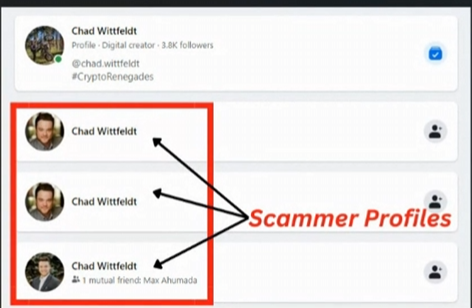 |
They messaged you first. There's no verification check mark. The account is thin, with a handful of posts and a few followers for somebody who supposedly reaches thousands. And the pitch asks you to send crypto to a platform they chose. |
So here's the rule that beats every version of it. We never message people first, we never manage anyone's crypto, and we never ask you to deposit on a platform we choose. Nobody honest does. So anyone who does one of those three things, with any name on the profile, is the scam. Our official channels are listed on the verification page.
How do you get out of a WhatsApp crypto scam?
Leave the group, block the numbers and stop sending money. In that order, today.
Don't pay the withdrawal fee, don't pay the tax, and don't send "one more deposit to unlock the account." Every dollar you send after the first withdrawal fails is a dollar you're choosing to hand over, and you've already seen the ending.
Then do the free things. Contact the exchange you bought the crypto on through its own app, the same day. File at ic3.gov and reportfraud.ftc.gov. And screenshot everything before the group vanishes. The full order is in how to report a crypto scam. And when a new number messages you a few weeks later saying they got scammed by the same group and found someone who recovered their money, that's the same operation on a different phone. So read legitimate crypto recovery companies before you reply.
What this page doesn't cover
Public Telegram channels run by real, named educators do exist, and they don't ask you to send funds. So the test isn't the app, it's the ask. A relationship that started on a dating app and moved to WhatsApp is the crypto romance scam, same ending with a slower start. And here's where I could be wrong. I say "never" about traders managing money on WhatsApp because in ten years I haven't seen the exception. If it exists, it's rare enough that betting on it is still the wrong bet.
Where this fits
The WhatsApp group, the romance scam, the imposter profile and the deepfake ad are four doors into the same room, which is a fake platform with your deposit in it. The four questions that catch all four before money moves are on how to spot a crypto scam, and the WhatsApp question is the first one.
And if you already sent the money, you're not alone and you're not stupid. In our own member survey, 92% of the people who came to us had been scammed before they found us. The way back starts with a one-day audit of what happened, and we walk you through it in week one: after a crypto scam, the way back.
So here's your job today. Open the group, count how many "members" have ever said anything other than thank you, and leave. Then tell one person what you were about to do. That conversation costs nothing, and it's worth more than any screenshot they'll ever send you.
This is education, not legal or financial advice.
Frequently asked questions
Yes, if anyone in it is offering to trade crypto for you or manage your account after you send funds. In over ten years I have never seen a legitimate crypto trader managing strangers' money over WhatsApp or Telegram. The members posting profits are usually part of the operation.
You are added to a group or messaged by an analyst or account manager. You send a small deposit and receive screenshots of your balance growing. When you ask to withdraw you are told to wait, then charged a withdrawal fee, then a tax, then the app is down and the group is gone. A recovery agent, often the same person, messages you a few weeks later.
Anonymity. Neither app requires identity verification to get a number or username, both are end-to-end encrypted, and neither has the sender registration that business texting in the US requires. A scammer can create an account in minutes with no tie to who they are.
Compare them to a screenshot of your own exchange app. Fake ones use fonts that match no real exchange, balances with too many decimal places, trade confirmations with no order IDs, and a profit chart that is just a green line going up. The second tell is the account manager getting angry when you ask to withdraw.
Stop sending money, including any withdrawal fee or tax. Leave the group and block the numbers. Contact the exchange you bought the crypto on through its own app the same day, file at ic3.gov and reportfraud.ftc.gov, and screenshot everything before the group disappears. Ignore anyone who later offers to recover the funds for a fee.
No. Impersonators have used our names and photos to pitch an inner circle where you send crypto to a platform they pick. We never message people first, never manage anyone's crypto and never ask you to deposit on a platform we choose. Our official channels are on the verification page.
Sources
General education only, not financial advice. Crypto and leverage involve substantial risk of loss. Read our risk disclosure.

Written by
Chad WittfeldtCo-Founder and Strategy Lead, Crypto Renegades
Chad first heard about Bitcoin in 2012, bought his first coin in 2013 at around $100, learned markets through forex in 2015 and went full time on crypto in 2017, posting public technical analysis on Bitcoin's break above $3,000 that August. That same year he flagged USI Tech and BitConnect as Ponzi schemes and warned the people around him before either one was exposed. He ran an Ethereum GPU mining operation from 2019 to 2021, and verification runs through everything he teaches.