Asked to pay tax to withdraw your crypto? It's a fake platform.
A crypto investment scam is a platform that shows your balance growing daily, pays the first small withdrawal, then invents a reason you can't have the rest. I've watched the same one get rebuilt since USI Tech in 2017.

Updated

A crypto investment scam is a platform you send crypto to that shows you a balance growing every day, pays out the first small withdrawal, and then invents a reason you can't have the rest. It's the biggest scam in this space by a mile, and I've watched the same one get rebuilt with a new name every few months since 2017.
The platform is a web page, and the deposit address is theirs. Nothing was ever bought, traded or mined on your behalf. The number on your dashboard is typed by the person who's about to take your money, and your "login" is the illusion of control.
Now, I called the first big one, USI Tech, for a man I respected back in 2017. He didn't listen. We'll get to that too.
So who's this for? It's for the person who's been sent a link to a platform, a cloud mining service or a "trading desk" that pays daily, and wants to know before the deposit instead of after. And if you're already in one and the dashboard says you've tripled your money... I'm sorry, and keep reading, because the next thing they ask you for is the part that actually costs you.
What's in the video: the daily-compounding pitch, why affiliate rewards are how a scheme with no revenue buys growth, and a real message thread with a woman who thought she was in a wallet app and was actually in a fake yield platform, right up to the moment she found the domain on the wallet's own warning list.
What does a crypto investment scam look like?
Send us your crypto, and we'll pay you daily compounding returns. That's the pitch, and it comes in three costumes.
There's the trading desk: "Our traders generate 1 to 2% a day and pass it to members." There's cloud mining: "Pay us, we buy and run the rigs, and we split the output." That one ran hard in 2020 and 2021 when mining was in the news. And there's arbitrage: "We exploit price differences between exchanges, so the market can't hurt you." Same scam, different brochure.
Underneath all three you'll find a working web app, a login, a balance that climbs every day, and an affiliate program that pays you a slice of everything your friends deposit. USI Tech and BitConnect, the two best-known examples, both grew on unusually generous referral rewards, because that's how a scheme with no revenue buys distribution. BitConnect ended in an SEC enforcement action and criminal charges from the US Department of Justice. The money coming in from new depositors was the "returns" being paid to the old ones, so when new deposits slow down, the music stops, and there are no chairs.
Nine times out of ten these are Ponzi schemes robbing Peter to pay Paul. And the tenth one is just a wallet address with a website in front of it.
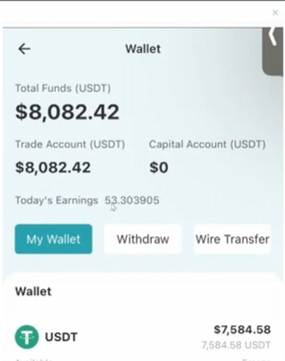
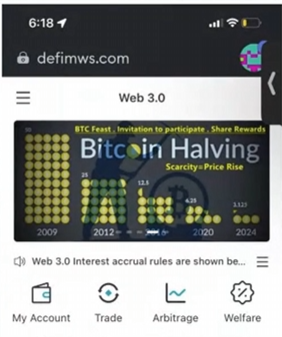
Here's what two of them look like, straight from the Scam Vault module. One is a fake wallet app, and the other is a fake platform dashboard. Notice how ordinary they look. That's the whole point.
The fake wallet
The fake platform
How did the platform scam evolve, and why does that matter?
Because the shape never changed. Only the paint did.
I watched USI Tech from the inside of somebody else's decision in 2017. It started as a Telegram bot. You messaged it, it gave you a wallet address, you sent bitcoin, and every day it pinged you with your "profit" and asked if you wanted to reinvest. Later it became a dashboard portal with charts. And every platform scam since has been a dashboard portal with charts.
The man who brought it to me was a commercial real estate broker with a whole portfolio of investment properties, respected in his world. He asked me to take a look, so I dug in and called it fast. The affiliate rewards were wildly out of proportion, people were being paid astronomical amounts just for referring others, and it was spreading far too quickly for anything real. I told him all of that. But he invested first and asked second, lost roughly $35,000, and wrote it off on his taxes for years.
That's the whole point of the story. The platform scam doesn't need you to be dumb. It just needs you to want the daily number more than you want the answer.
What is the tell that gives away a crypto investment scam?
"Have you heard of this platform?"
Like clockwork. When somebody asks me that question about a platform, a trader or a mentor, the answer is almost always no, and that's the finding. Here's why. Scam platforms rebrand every two or three months, as soon as the name gets outed on Reddit or in a Facebook group. So by the time you finally search, you find the platform's own website and nothing else. No reviews, no history, no articles. A real exchange has years of coverage crowding the results, while a fake one has a landing page that looks like it was thrown together yesterday with the text overlays slightly out of place. The most common one I've seen lately is Trust Traders Hub, and I've watched a lot of people get caught on that site.
Now compare that to the checker question I teach: do you have to use their platform to take part? Anyone honest teaching this lets you trade wherever you're comfortable and will name several venues. But if the opportunity only exists on one platform, and they control it, then they control the back door too.
Why is the first withdrawal the most dangerous moment?
Because it works.
A woman messaged me convinced she was having trouble withdrawing from a popular hot wallet. Now, I knew that wasn't possible, because a hot wallet runs straight on the blockchain and the only thing that ever stops a withdrawal is not having enough for the gas fee. So I asked her what she was actually looking at, and she sent a screenshot. It wasn't the wallet at all. It was a "Web3 yield" site with an earnings page, a trade page and an "arbitrage" page, all dressed up in the wallet's colors. She'd been told to connect through it as a "security feature." And she'd withdrawn $150 once, for less than $15 in gas, so it felt real. Now her USDT was "growing every day" and support was telling her the account had been flagged for review.
By the end of the thread she'd found the platform's domain on the wallet's own warning list. "Oh my God." That's the moment, and I've seen it a hundred times.
So that $150 withdrawal was never a glitch in the scam. It was the scam. They let you take a little out so you'll put a lot in. The real test was never whether one withdrawal cleared. It's whether you can move your full balance, right now, to an address you chose, without asking anyone.
What happens when you try to withdraw from a crypto investment scam?
The squeeze. Every time.
First they talk you out of it: "it's a bad time, you're about to make so much more." Then the account needs a tax paid before withdrawal. Then a fee. Then a verification deposit. Then it's under review. And that's the platform's last effort to get more out of you, because they know you're catching on.
Now, two legitimate withdrawal frictions do exist, and they're both boring: a two-factor confirmation from your own device, and a hold of a few business days on a brand-new account's bank deposit. Neither one asks you for more money. So anything that asks you to send money in order to send money out is the scam telling you exactly what it is.
What this page doesn't cover
Token scams, meaning the pump and dump, the rug pull and the honeypot, are a different animal: a real token with a fake future, instead of a fake platform with a fake balance. They'll get their own page later. A hacked wallet or a compromised wallet app is a custody failure, not a scam, and the fix for that is on hot wallet vs cold wallet. And here's where I could be wrong. A yield product from a real, regulated company can exist. It'll have a name you can find and a history you can read, and it will never require you to recruit your friends to get paid.
Where this fits
The fake platform is where almost every other scam ends up. The romance scam walks you onto one through a relationship, and the WhatsApp group is the same thing with the web app ripped out and an "account manager" in its place. When the platform stops paying, the recovery agent shows up next, so read legitimate crypto recovery companies before you answer that message. The four questions that catch all of it are on how to spot a crypto scam.
And if you're already in one, the way back starts the day you stop sending and start auditing. That's what week one looks like for new members who got scammed first: after a crypto scam, the way back.
So here's your job this week. Take the name of any platform, trader or "program" you've been considering and search it, two or three pages deep. If the only result is its own website, you have your answer. Ten minutes beats $35,000.
This is education, not legal or financial advice.
Frequently asked questions
A platform you send crypto to that shows your balance growing every day, pays out the first small withdrawal, and then invents a reason you cannot have the rest: a tax, a fee, a verification deposit, an account under review. The dashboard is a web page, the deposit address belongs to the scammer, and nothing was bought, traded or mined for you.
They offer daily compounding returns under one of three covers: a trading desk, cloud mining or arbitrage. A working web app shows a climbing balance, an affiliate program pays you a slice of what your friends deposit, and new deposits fund the withdrawals of earlier depositors until new money slows down and withdrawals stop.
Search its name two or three pages deep. A real exchange has years of coverage. A scam platform, which rebrands every two or three months, turns up only its own website. Also ask whether you are required to use that specific platform to take part; honest teachers let you trade wherever you are comfortable.
No. The first small withdrawal is allowed on purpose so you deposit more. The real test is whether you can move your full balance, right now, to an address you chose, without asking anyone. If the answer involves a support ticket or a tax, you do not have control.
USI Tech was a 2017 platform that promised daily returns on bitcoin, started as a Telegram bot and grew on outsized referral rewards. Regulators in several jurisdictions issued warnings and it collapsed. It is the template every platform scam since has followed, alongside BitConnect, which ended in SEC and DOJ actions.
Stop sending money for any reason, including taxes or fees to unlock a withdrawal. Contact the exchange you sent from through its own app, file at ic3.gov and reportfraud.ftc.gov, save every screenshot and transaction hash, and ignore anyone who offers to recover the funds for a fee.
Sources
General education only, not financial advice. Crypto and leverage involve substantial risk of loss. Read our risk disclosure.

Written by
Chad WittfeldtCo-Founder and Strategy Lead, Crypto Renegades
Chad first heard about Bitcoin in 2012, bought his first coin in 2013 at around $100, learned markets through forex in 2015 and went full time on crypto in 2017, posting public technical analysis on Bitcoin's break above $3,000 that August. That same year he flagged USI Tech and BitConnect as Ponzi schemes and warned the people around him before either one was exposed. He ran an Ethereum GPU mining operation from 2019 to 2021, and verification runs through everything he teaches.