Got a Coinbase scam text with a verification code? Don't call.
A Coinbase scam text is a mass-sent message with a phone number to call. I called one and recorded the call. Here's what the texts say, how the call runs, and the one-line answer.

Updated
Delete it. Ignore it. It is not legitimate.
A Coinbase scam text is a message pretending to come from Coinbase, telling you a withdrawal, a new device or a login just happened on your account and giving you a phone number to call. Coinbase did not send it. That number connects you to a call center, and the folks on the other end will spend the next 45 minutes talking you into moving your crypto into a wallet they control.
Now, a member sent me one of these a few hours before I recorded the call below. So I threw on my sunglasses, got into character and called the number. The whole thing is on video, including the email they sent me with their recovery phrase in it.
So who's this for? It's for the person holding the text right now with their heart rate up and their thumb hovering over the number. And if you're hoping somebody will tell you it might be real... I can't do that, and neither can anyone else who's actually seen one of these play out.
What's in the video (19 minutes, cut down from a call that ran about 45): the four text variants on my own phone, the call from the hold message all the way to the "senior advisor," the exact questions they ask, the lookalike email with a case reference, the moment they hand me a recovery phrase, and what the scammer said when I told him the whole thing was recorded.
What does a Coinbase scam text say?
There are four versions going around right now, and they all land the same way: something just happened on your account, so call us.
- "Here's your withdrawal code. If you did not authorize this withdrawal, call this number, reference CB1056."
- "Your app has been registered on a new device, Samsung. If this was not you, call us immediately."
- "We have an API login from a Samsung S26 in Vancouver, Canada. Call this number."
- "Your Coinbase verification code is 702601. Do not share this code. If you did not request it, call this number."
And here's the rule that holds for every real exchange. A real exchange will never ask for your password, your two-factor codes or your recovery phrase, and a real security alert sends you into the app, not to a phone number in a text. So a real alert points you to the app, and a fake one points you to a stranger.
And the withdrawal code one is the sharpest of the bunch, right? Because you didn't request a withdrawal, so your brain goes straight to "somebody is in my account." That's exactly the point.
Is the Coinbase scam text targeting me?
No. And honestly, this is the part that calms people down the fastest.
You are not being specifically targeted. Your data wasn't leaked, and they don't know you have a Coinbase account. They're blasting these texts out to as many phone numbers as humanly possible on the bet that there are enough fish in the pond for somebody to bite. That's also why the number texting you usually carries a foreign country code... the operation isn't anywhere near you.
Now, here's the thing folks always say to me: "But Chad, it came right after I closed the app. Right after I set up a transfer. Right when the market dumped." I know. It feels timed, but it isn't. It's volume. When the market moves, everybody checks their app, so whatever text lands that day FEELS like it knew something. And these texts spike when the market moves for exactly that reason, because more people are nervous, more people are logged in, and more people call.
So timing you can't explain is really just a coincidence you happened to be paying attention to. That's all it ever was.
What happens if you call the number on a Coinbase scam text?
I did, so you don't have to. And here's the script, almost beat for beat.
It starts with a hold message. "Welcome to Coinbase, all calls are recorded for training, monitoring and security purposes." Then a first agent picks up, polite and calm, confirms the breach, and starts asking questions: when did you last log in, can you log in now, what's your first name, what's your total balance, which tokens are you holding, how much of your top three, do you use a VPN, how often do you check the account.
Now read that list again, because a real exchange can already see every one of those answers. They're asking so you'll feel like a customer talking to support, and so they know exactly how much is on the table before they make their move.
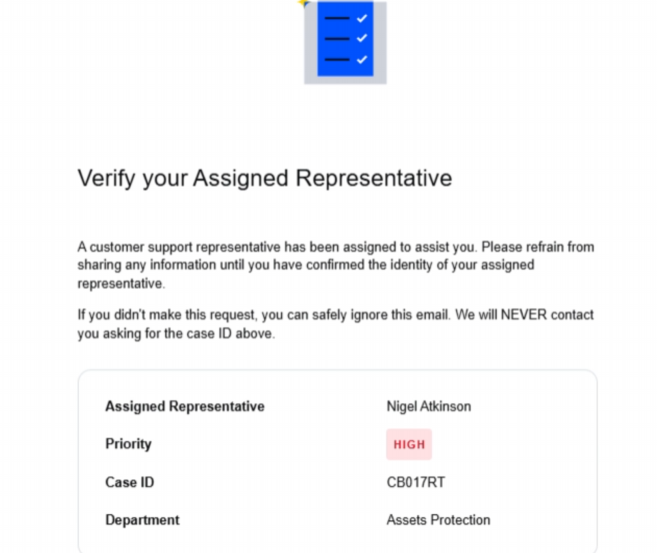
Then you get transferred to a "senior advisor," who opens with: "Coinbase will never ask for your PIN, password or banking information." Which is true. And it's said for one reason, which is to buy your trust before the ask. Right about then an email shows up from a lookalike address with a case reference spelled out in the NATO alphabet, Charlie Bravo 017 Romeo Tango, because that's what a bank sounds like.
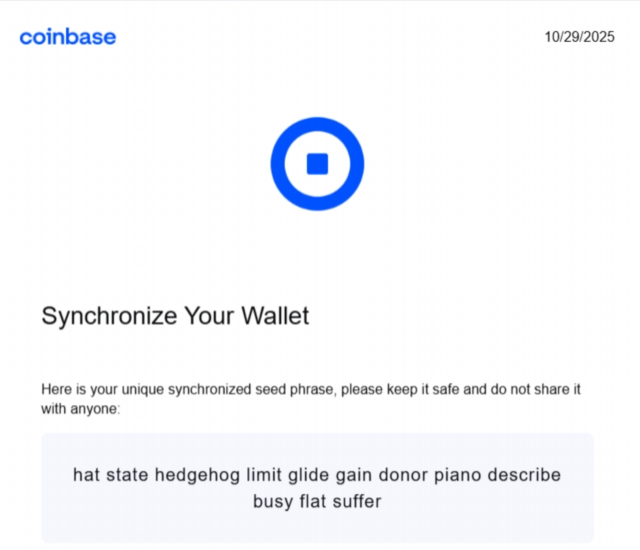
And then comes the pivot. Your account has to be locked for a seven to fourteen day investigation, so your assets need to sit in "a decentralized platform that only you can access" for the duration. I offered up my own wallet, and he talked me out of it, because an attacker with access to my exchange account could supposedly see my old withdrawal addresses, so I needed a fresh one. And wouldn't you know it, the recovery phrase for that fresh wallet was already sitting in my email. Twelve, eighteen or twenty-four words. "Please do not call that out loud. This is for you and you only."
That one instruction is the whole trick. Real seed phrase hygiene, never say it out loud, gets used against you so you don't notice the only thing that actually matters... they picked the words. Import their phrase and you're standing in their wallet, and everything you move "to safety" is theirs.
And here are the two emails, exactly as they landed in my inbox during the call. The first one "verifies" the representative. The second one hands me the recovery phrase.
The "verify your representative" email
The email with their recovery phrase
Twenty-five minutes in and they still hadn't asked me to move a single coin. That patience is the weapon. Nobody expects a scam to be this polite for this long.
Why does the Coinbase text scam work on smart people?
Panic gets built on intentionally. That text is engineered to make you believe someone is in your account right now. And when that panic sets in... the red flags you'd catch at any other moment seem to go invisible. So you pick up the phone, and that's where the authority gets stacked on top: hold music, a recorded-line notice, a case number, a "senior advisor," questions that sound like a compliance desk. And if you're new to crypto, half their questions go over your head, and that's intentional too. Confusion reads as expertise.
These people do this all day, every day, and they're good at it. The guy on my call told me he "used to do credit cards." This is a career for them.
And here's the line I keep coming back to. When I told him I knew what he was, he handed me the defense himself: "Go through official channels. They've got a number, they've got chat, they've got email support." The scammer's advice is the best advice on this page.
What should you do with a Coinbase scam text?
- Delete it. Don't reply, don't click and don't call. Replying just confirms the number is live.
- If you're worried, open the app yourself. Not a link in the text. The app on your phone that you installed. If something happened to your account, it's in there, and if nothing's in there, nothing happened.
- Never call a phone number that arrived in a text. Real support lives inside the app and on the help site you typed in yourself.
- Never import a recovery phrase someone gave you. A seed phrase gets generated by you, on your device, and nobody else ever sees it. So anyone handing you one is handing you their wallet.
- Report it. Forward the text to 7726 (that spells SPAM) so your carrier sees it, report the phishing attempt inside the app you installed yourself, and file at reportfraud.ftc.gov or ic3.gov if you actually lost something.
Members don't send me these texts anymore, and it's not because they stopped getting them. Everybody gets them. They stopped sending them because spotting one is the first thing they learn, and after week one it's just noise.
What this page doesn't cover
The email and phone-call versions of this scam run the same script, and I've seen both, but the video shows the call. A real account takeover through a SIM swap or a stolen password is a different problem with different fixes, and this page isn't about that. And if you already called, already imported their phrase and already moved funds, read legitimate crypto recovery companies before you do one more thing, because the next scam is already dialing your number.
Where this fits
The same impersonation play runs with our own names on it. Impersonators using our names and faces message strangers every day, and the tells are on our verification page. The reason panic works on anyone, plus the three questions I walk people through after it does, are in why people get scammed in crypto. And every scam on this site runs through the four-question check in how to spot a crypto scam.
If you already got caught by one of these, you're not stupid and you're not alone. In our own member survey, 92% of the people who came to us had been scammed before they found us. So the way back starts with a one-day audit of what happened, and we walk you through it in week one: after a crypto scam, the way back.
Your job today is simple. Delete the text, open the app yourself, and tell one person who holds crypto what the four variants look like. That's the whole defense, it takes thirty seconds, and it works.
This is education, not legal or financial advice.
Frequently asked questions
A Coinbase scam text is a message pretending to come from Coinbase, claiming a withdrawal, a new device or a login just happened on your account, and giving you a phone number to call. Coinbase did not send it. The number reaches a call center that talks you into moving your crypto into a wallet they control.
No. A real exchange alert sends you into the app, not to a phone number, and no real exchange asks for your password, two-factor codes or recovery phrase. If you are worried, open the app you installed yourself. If something happened to your account, it is there.
A mass-sent text that says a withdrawal code was issued and tells you to call a number if you did not authorize it. You did not request a withdrawal, so the text is built to make you panic and call. Delete it and open the app yourself.
A hold message, a recorded-line notice, then an agent who asks for your balance, your top holdings and how often you log in. You are transferred to a senior advisor who says your account must be locked for 7 to 14 days and your assets moved to a new wallet, using a recovery phrase they email you. Importing that phrase gives them your crypto.
Delete it. Do not reply, click or call. Open the Coinbase app yourself to check your account. Forward the text to 7726 (SPAM), report the phishing attempt inside the app you installed yourself, and file at reportfraud.ftc.gov or ic3.gov if you lost anything.
Coincidence, not targeting. The texts are sent in bulk to as many numbers as possible and spike when the market moves, which is exactly when most people are checking their apps. The timing feels personal because you were paying attention.
Sources
General education only, not financial advice. Crypto and leverage involve substantial risk of loss. Read our risk disclosure.

Written by
Chad WittfeldtCo-Founder and Strategy Lead, Crypto Renegades
Chad first heard about Bitcoin in 2012, bought his first coin in 2013 at around $100, learned markets through forex in 2015 and went full time on crypto in 2017, posting public technical analysis on Bitcoin's break above $3,000 that August. That same year he flagged USI Tech and BitConnect as Ponzi schemes and warned the people around him before either one was exposed. He ran an Ethereum GPU mining operation from 2019 to 2021, and verification runs through everything he teaches.