Crypto Mastermind, explained
A Crypto Mastermind With Live Trade Calls
and Real Trade Reviews
A crypto Mastermind is a group that learns to trade together: live calls, coaches who review your work and members at the same stage. Most people don't need another course. They need someone watching them use the one they already took. Want signals to copy? This isn't it. Want to own the process? Here's how a Mastermind works, how it differs from a course or a signals group, and what to check before you join any of them.
What is a crypto Mastermind?
A crypto Mastermind is a membership where people learn to trade in the market together, with experienced traders running live sessions, reviewing members' charts and answering questions as they come up. The difference from a course is the environment. You're not watching alone. You're doing the work in front of people who can see where it goes wrong.
How is a Mastermind different from a trading course, really?
A course gives you information. You watch a video, then another video... and then you're on your own in a live market, right?
Here's the thing. Most people don't fail for lack of information. As Chad Wittfeldt puts it, "We all have access to the same information." They fail in the gap between knowing a rule and applying it the same way on the fortieth trade as on the first.
We wrote about that gap in why your last trading course didn't work, and we compare the options side by side in course, signals or Mastermind. If you're weighing specific programs, our guide to comparing crypto mentorship programs lists what to check, and our side-by-side with Decentralized Masters applies those checks to two programs using each one's published terms.
A Mastermind closes the gap with three things a course leaves out:
- Guided implementation. You take what you learned into the market step by step, on live calls, with someone watching the process instead of the result.
- Feedback. You find out whether you applied it correctly, from coaches and from members who are a few months ahead of you.
- Community. People on the same learning curve, who ask the questions you were about to ask and notice when you drift from your plan.
Information is not the problem. It's the implementation.
Where did this Mastermind start?
In a Facebook Messenger chat between Niko Mercuris and Chad Wittfeldt in 2020. Friends and family kept asking how they were approaching crypto, and the chat grew from two people to twenty to a hundred. So the founders started teaching it properly. Today there are thousands of members across the world, and the community is still the part members mention first.
What happens inside
Four platforms, one community: live calls on Zoom, the trade chat and help desk on Discord, step-by-step training on Skool and every call replay in a private Facebook group.
Live trading calls
Eight live sessions a week. Niko trades live on Zoom every Monday, Wednesday and Friday at noon ET, Chad runs live trading Tuesday at 6 PM ET and a rotating coach leads Sunday at 8 PM ET. Basics calls run Tuesday at noon and Thursday at 5 PM ET, and onboarding is Friday at 2 PM ET. It's open mic. Share your screen and ask if your lines are right.
Coaches, not just founders
A coaching team led by Bill Cook, who joined as a member, plus lead traders who came up through the community and now run their own calls. Different traders, different styles, one risk process.
A Basics cohort for beginners
New members start with onboarding and a Basics cohort of people at the same stage: setting up accounts, placing a stop, choosing contract size and setting leverage, one step at a time.
A help desk and a trade chat
Ask anything in the help desk or the trade chat on Discord. The help desk responds in under 10 minutes during business hours. When enough members get stuck on the same thing, it becomes a live training.
One-on-one chart reviews
Send in a chart, an analysis or a trade you already took and get a recorded video walkthrough back: what you did well, what to change and why.
Replays and a training library
Every live call is recorded to the private group, with questions answered under the replay. Step-by-step training lives in the membership library.
Why the community is the product
Why does learning with other people work better?
Ask yourself one question. How many people do you know that you can talk to about crypto at a serious level? For most people, the answer is zero. Chad's description of the alternative is blunt: "It's kind of the blind leading the blind out there." A community fixes that in a practical way. Someone has already made the mistake you're about to make, and they'll tell you before you make it.
Here's what that looks like on an ordinary morning in the trade chat: members comparing their read on market structure, levels and all, before anyone takes a trade.
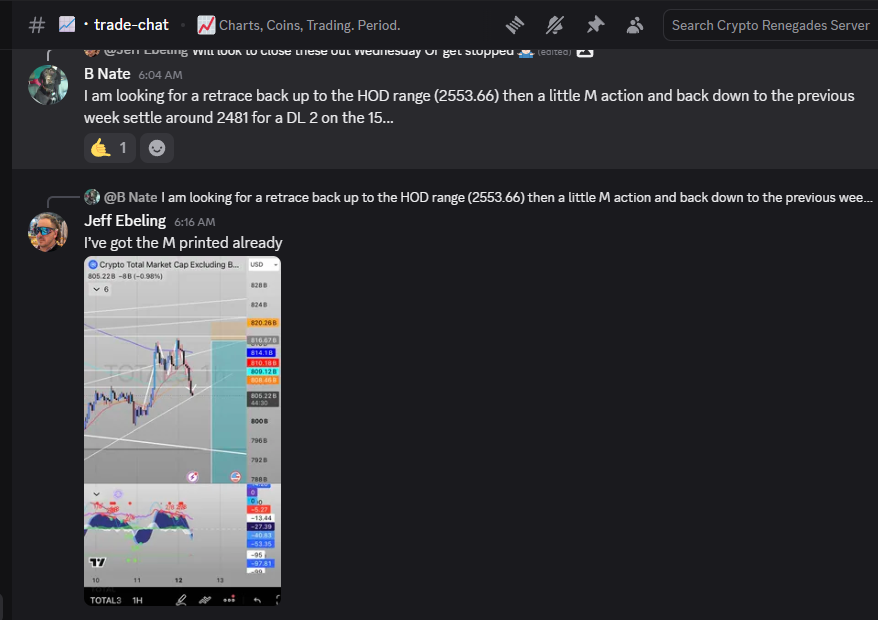
It also changes how you show up. When thirty people on a call are working through the same setup, a beginner question stops feeling like a confession. Niko says it on most calls: "There's no such thing as a dumb question."
Members post their work where the group can see it, too. The wins wall is the channel for closed trades, and its full name asks for the trades you lost and learned from as well. This is one member's closed position, not a typical result. The point is that the work is out in the open, where other people can learn from it and question it.
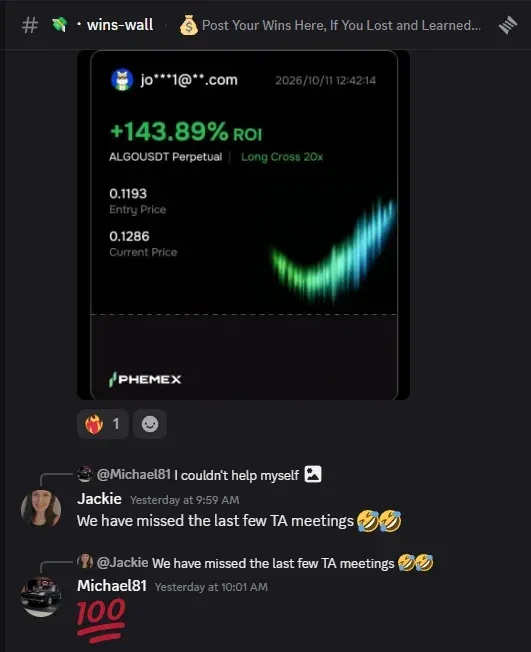
Going it alone sounds tough. In practice, it usually just costs you more.
Why does a Mastermind need so many coaches?
Because two founders can't answer every question, and one trading style doesn't suit every schedule. Some members trade around a full-time job. Some trade around a business. Live calls run across the week with different traders, so you can find the approach that fits your personality and your timeframe. The risk rules stay the same. ALWAYS.
And the small stuff gets handled too. Here's the help desk on a Thursday, with Bill walking a member through a Discord setting so the channels show up where they should.
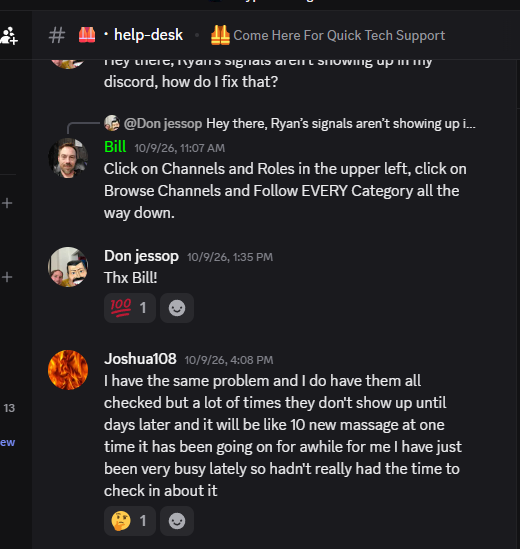
Where do the coaches come from?
Most of them came through the program. They came in not knowing how to trade. They got good at the process, started answering other people's questions in the chat, got invited to run a live call and ended up teaching the newcomers. Niko describes the shift as going "from a solitary trader to being in a group of people that actually love you, and respect you, and care about you now." Nobody is required to do that. As he puts it, "we do seem to attract people that want to step up and help once they learn."
That's not a perk. That's the process getting passed on.
So what do you learn first in the Mastermind?
Risk. Before strategy, every single time. Every position starts with the seven decisions of the Decision Protocol: a written thesis, a defined invalidation level, a position size worked out from that level, a check on total exposure and a plan for entry and exit, then a journal entry and a review afterward. The full sequence is in the Decision Protocol and crypto risk management, and the whole learning order, from foundation to portfolio, is laid out in The Crypto Roadmap.
The crypto gurus lead with the strategy because it sells. We lead with the stop because it keeps you in the game.
We focus on application, not just learning.
Learning a strategy takes an afternoon. Applying it the same way every time, through boredom, excitement and a bad week... that takes structure, feedback and people who notice when you drift.
That's what the Mastermind is for. The calls, the reviews and the chat exist so the process you learned is the process you actually use.
Everybody loves the community aspect because we all want to see each other rise together.
- the year Crypto Renegades started
- 2020
- the year Crypto Renegades started
- live sessions every week, all recorded
- 8
- live sessions every week, all recorded
- reviews on Google
- 95
- reviews on Google
- Trustpilot rating from 58 reviews
- 4.8
- Trustpilot rating from 58 reviews
Review counts as of October 2026. Read every review at the source on our reviews page.
What to check before you join any Mastermind
Ours or someone else's, answer these first. Anyone worth their salt will be glad you asked.
- 01
Can you research the people running it?
Real names, real faces and a history you can check outside their own website. If the leaders are anonymous, that's your answer.
- 02
Can you watch them teach before you pay?
A free class or a recorded live session shows you how they think, how they handle a loss and whether they answer hard questions.
- 03
Is risk taught before strategy?
Ask what the first weeks cover. If the answer is a strategy instead of stops, sizing and exposure, the order is backwards.
- 04
Do they stay away from your money?
A Mastermind teaches. It never manages your capital, holds your funds or asks you to deposit with them. Period.
- 05
Are results framed honestly?
Look for disclaimers, losses shown next to wins and no promise of a fixed or certain return. Income screenshots are marketing, not evidence.
- 06
Are price and refund terms clear before you pay?
You should know what it costs, what happens if you cancel and what the refund policy says before you commit.
Members, in their own words
Long-form interviews about where they started and what changed in how they make decisions.
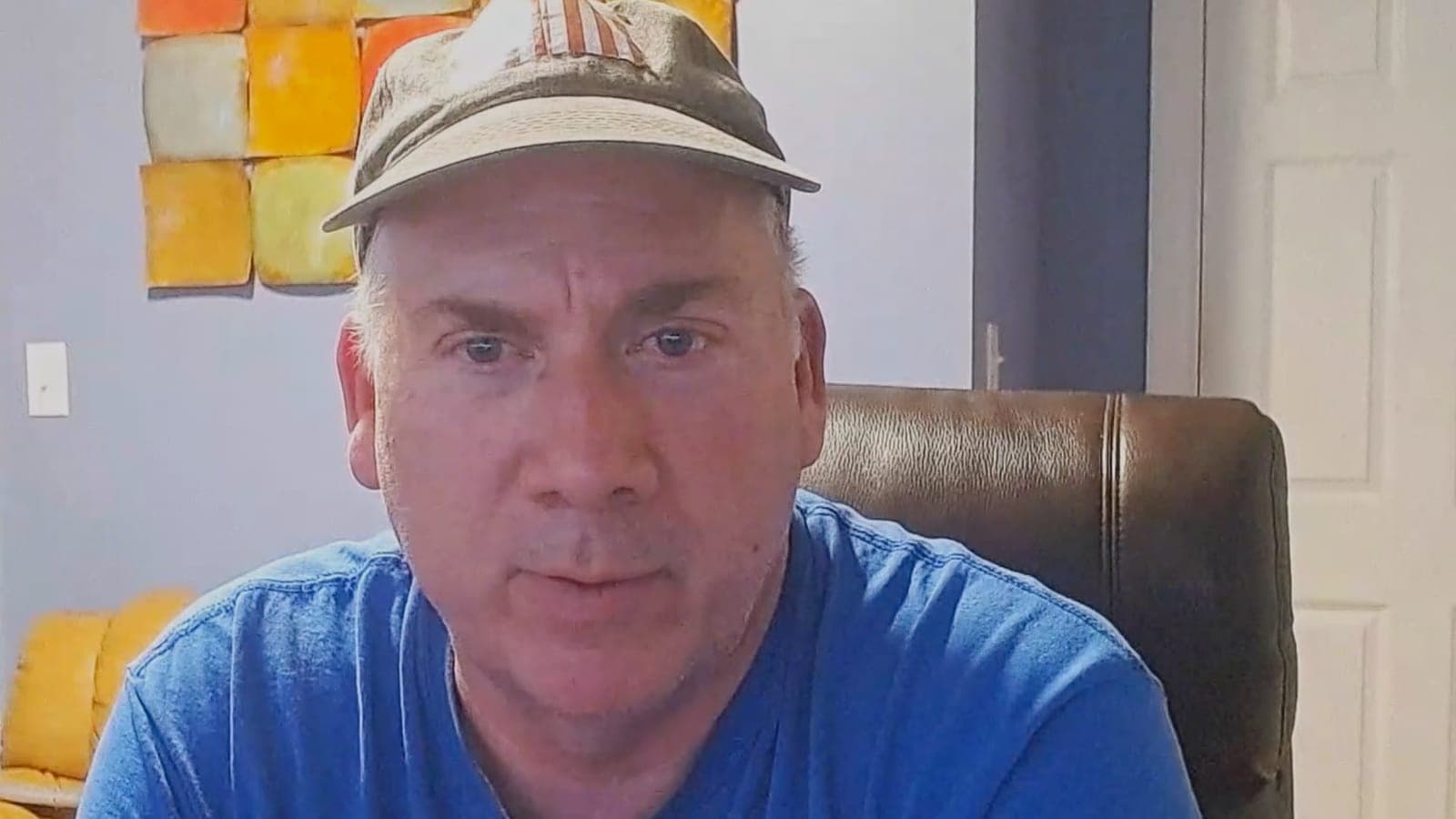
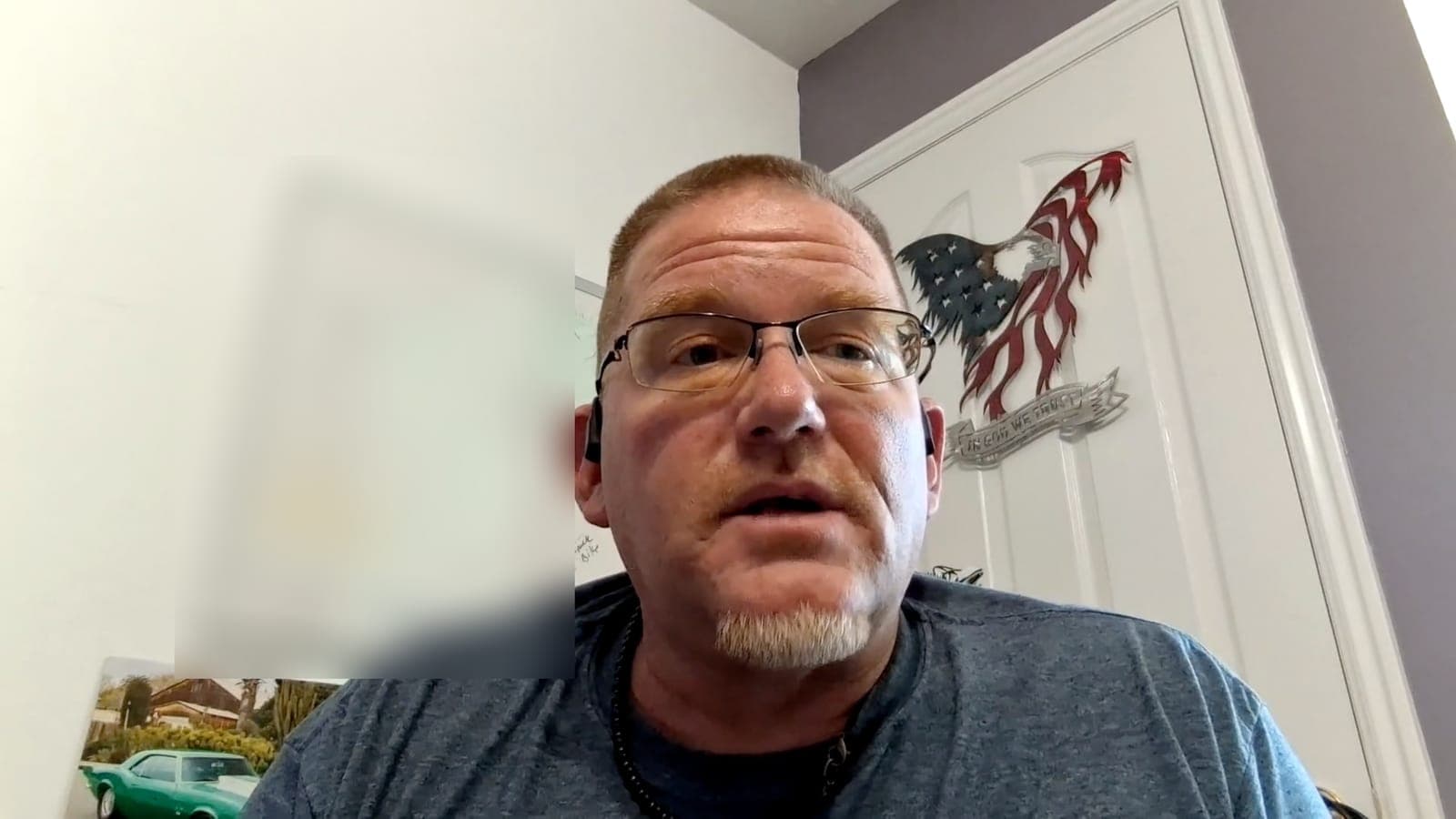
Individual experiences vary. This member's story describes their own experience and is not a typical or expected result. Crypto trading, especially with leverage, carries substantial risk, including the loss of the capital you commit. Nothing here is financial advice.
Who a Mastermind is for
Not a fit if you
- Need trading income to cover this month's bills and expenses
- Want signals to copy without ever learning the reasoning behind them
- Look for someone else to blame when a position goes against you
- Want someone else to manage your capital and make the calls
- Cannot give it a few hours a week on a consistent, ongoing basis
- Treat other members with impatience, disrespect or contempt
A fit if you
- Can cover your bills while you take the time to learn the skill
- Want to understand why a trade is taken, then find your own
- Own every decision you make, including the ones that do not work
- See crypto as an asset class and trading as a skill to build
- Can commit four to five hours a week to showing up and doing reps
- Ask questions, including beginner ones, and help others when you can
What the Mastermind does not do
Does the Mastermind trade for me?
No. We don't manage anyone's capital, we never hold member funds and nobody places a trade on your behalf. Instructors share their own positions and analysis on calls and in the chat so members can study the reasoning behind them: the thesis, where the trade is invalidated and how it was sized. Every decision in your account is yours. That's the whole point.
Is trading crypto risky?
Yes. Crypto is volatile, and trading it, especially with leverage, carries real risk. No process removes that, and anyone who tells you otherwise is selling something. What a process does is decide in advance how much of your capital a single position can put at risk, keep that number small and make the decision before you're excited about the setup.
How much time does a Mastermind take?
We ask for at least four to five hours a week. You don't need to watch charts all day. But the members who make progress are the ones who show up to calls, do the work between them and ask for feedback. Nobody can do the reps for you.
How do I check who you are?
Read every review at the source on our reviews page, watch the founders' interviews on our press and interviews page and use our verification page to confirm any account that claims to speak for us. What membership includes, the weekly schedule and how joining works are on the Mastermind membership page, and every way to learn with us, from the Skool Community to one-on-one time and tax bookkeeping, is on our services page. Do your homework on us. We'd want you to.
Questions about the Mastermind
A crypto Mastermind is a membership where people learn to trade together, with experienced traders running live sessions, reviewing members' work and answering questions. Unlike a course, the learning happens while you apply it, with feedback from coaches and members at the same stage.
It solves a different problem. A course gives you information; a Mastermind adds guided implementation, feedback and a community around that information. If you already understand the material but do not apply it consistently, the missing piece is usually implementation and feedback, not another course.
Check that the leaders are real people you can research, that you can watch them teach before you pay, that risk is taught before strategy, that they never handle your money, that results are framed with disclaimers rather than income screenshots, and that the price and refund terms are clear before you commit.
No. Many members start with no trading experience at all. New members go through onboarding and a Basics cohort with people at the same stage before they join the main live trading calls.
The two co-founders, Niko Mercuris and Chad Wittfeldt, run live calls during the week. A coaching team led by Bill Cook handles onboarding, the Basics cohort and the help desk, and lead traders who came up through the community run their own calls, including on weekends.
There are eight live sessions a week. Niko trades live on Zoom every Monday, Wednesday and Friday at noon ET, Chad runs live trading Tuesday at 6 PM ET and a rotating coach leads Sunday at 8 PM ET. Basics calls run Tuesday at noon and Thursday at 5 PM ET, and onboarding is Friday at 2 PM ET. Every call is recorded to the private group, so you can watch the replay and ask questions under it.
No. We never manage capital or hold member funds. Members open and control their own accounts, and every decision in them is theirs. Instructor positions are shared as study material so members can learn the reasoning behind them.
[Apply for the Mastermind](/book/), then talk it through with our team. We screen every applicant to protect the culture of the community, and if it is not the right time for you we will say so.
See if the Mastermind fits.
If you want someone to trade for you, this isn't it. If you want the skill and you're ready to own every decision, apply for the Mastermind and talk it through with our team. We screen every applicant, and sometimes the honest answer is not yet.
5.0Based on 95 reviews