What is profit factor in trading? The number that matters more than win rate
Profit factor is gross profit divided by gross loss, and it tells you whether your winners paid for your losers. The formula, an illustrative worked example, what a good profit factor in trading looks like and how to track it honestly.

Updated
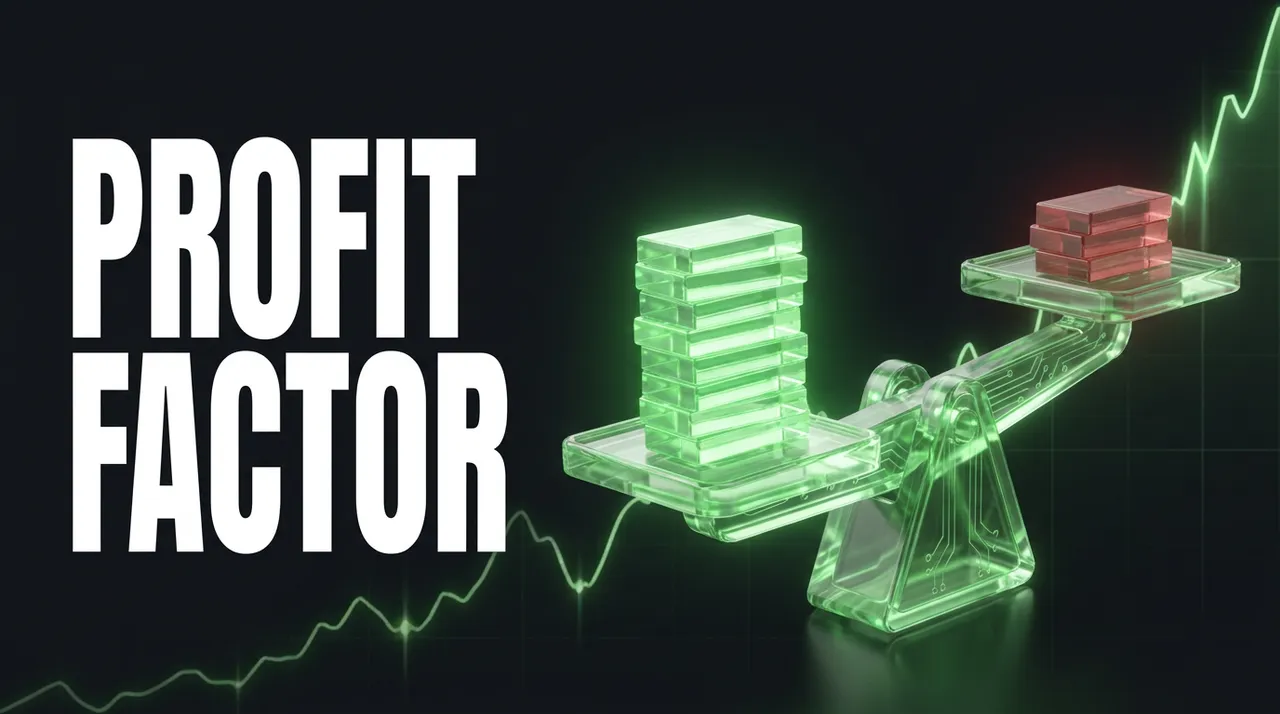
What is profit factor in trading? Profit factor is your gross profit divided by your gross loss over a set of trades, and it's the number I care about more than win rate. Above 1.0, your winners paid for your losers and then some. Below 1.0, they didn't.
It's a simple formula, and most traders still never work it out. I think I know why... it's a lot more fun to count your wins than to add up what your losers cost.
The traders who get the most out of this number are the ones who'd rather know than feel good. If you keep a trading journal, or you're ready to start one, and you want a number that tells you the truth about your process, keep reading. If you judge your week by how many trades went green, this post is going to bug you a little, and that's exactly the point.
What is profit factor in trading, and how is it calculated?
Profit factor is gross profit divided by gross loss. Gross profit is the total dollar result of every winning trade. Gross loss is the total dollar result of every losing trade, written as a positive number. Fees and funding come out of each trade first, so you're always working with the net result. The charting platform TradingView describes it the same way, as the absolute value of all winning trades divided by the absolute value of all losing trades.
Profit factor = gross profit / gross loss
- Above 1.0: the winning trades outweighed the losing ones.
- Exactly 1.0: break even.
- Below 1.0: the losing trades won.
That's it. It's three numbers and one division, and it tells you more about your trading than a month of screenshots.
Can you show me a profit factor calculation with numbers?
Here's an illustrative example, not anyone's results. Picture a $2,000 account risking 1% at the stop on every trade, which is $20. Every trade passes the 1:3 filter, so the target is at least three times the risk, or $60. Over 20 trades, it plays out like this:
| Result | Trades | Each | Total |
|---|---|---|---|
| Target hit at 3R | 5 | +$60 | +$300 |
| Closed early at 1.5R | 2 | +$30 | +$60 |
| Stopped out at 1R | 13 | -$20 | -$260 |
Gross profit is $360. Gross loss is $260. The profit factor is 360 divided by 260, about 1.38. Now add $1 of fees to every trade. Gross profit drops to $353, gross loss rises to $273, and the profit factor falls to about 1.29.
Notice something? This trader got stopped out far more often than they hit a target, right? And the profit factor is still above 1.0. That's the 1:3 risk reward filter doing its job, because one full target at 3R pays for three stops.
The filter decides the shape of every trade before you place it. Profit factor tells you afterward whether that shape held up.
What is a good profit factor in trading?
A good profit factor in trading is one that stays above 1.0 after fees and funding, measured over at least 20 to 30 trades of the same setup, with the same risk on every trade. That's the honest answer, and you won't get a magic number from me.
Why not? Profit factor is a reading on your process, not a target to trade toward. The moment it becomes a target, people start doing costly things to protect it, like grabbing tiny profits early or leaving a losing trade open so it doesn't count yet.
Three things decide whether the number means anything:
- Enough trades. Five trades with one big winner can show a profit factor of 4.0 and mean absolutely NOTHING.
- The same risk every time. If one trade risked 4% and the rest risked 1%, that one trade decides the whole figure. We start new traders at 1 to 2% per trade and keep it fixed, with the size set from the stop. Our guide to position sizing walks through how.
- Costs included. On small targets, fees and funding are often the whole difference between above 1.0 and below it.
And anyone selling you a course with a giant profit factor on the sales page and no journal behind it? Ask for the journal. Watch how fast the subject changes.
A 1.2 you can trust is worth more than a 3.0 you can't.
Why does trading profit factor matter more than win rate?
Win rate isn't the point. Profit factor is. That's one of the core rules in how I teach trading, and it's not up for debate.
Win rate only tells you how often you were right. Profit factor tells you whether being right paid for being wrong. A trader who grabs small wins and takes full-size losses can win most of their trades and still sit below 1.0. A trader who only takes trades that pass 1:3 can lose more often than they win and still sit above it. We do track win rate, as one metric among several in the journal. We never treat it as a goal, and we never publish one.
A win rate looks great in a screenshot. Profit factor is what tells you whether the process is actually working.
How is one of our members using profit factor to get consistent?
Let me tell you about Sarah, one of our members. Right now she's taking $3 trades, meaning $3 risked at the stop on each one. And she's getting more consistent every week, because she isn't staring at her balance. She's focused on her profit factor, the risk to reward on every trade, and her win rate, tracked as just one metric next to the others.
Here's why that works. Profit factor is a ratio, so it doesn't care about size. Twenty trades at $3 tell her the same thing about her process that twenty trades at $300 would, and the lesson costs her about as much as a few cups of coffee. So the emotion is out of it, and what's left is the data. That's what I mean by process over profits.
The size comes later, once the numbers hold over enough trades. Skipping that step is how most accounts blow up, and I break down exactly how in why do traders lose money.
The dollar amount is the last thing that should grow. The process grows first.
How do you track your profit factor without fooling yourself?
Log every trade, including the ones you'd rather forget. Use the net result after fees and funding. Tag each trade with the setup you used. Then every 20 trades, run the division for each setup on its own. If one setup sits below 1.0 after 30 trades, it gets fixed or it gets dropped.
Deleting the ugly trades from your journal doesn't improve your profit factor. It just means you're lying to the one person who needs the truth.
What's your profit factor right now?
Pull up your last 20 closed trades, or start a journal today if you don't have 20 yet. Add up every winner, add up every loser with fees included, and divide. Write that number at the top of your journal, and write the date next to it.
Counting green trades feels good for a week. Knowing your profit factor is what still tells you the truth a year from now, and all it costs is one evening with your journal.
If you want coaches checking your journal and your numbers every week, try our Skool Community free for a week, then $97/month.
This is education, not financial advice. The trades in this post are illustrative examples, not results.
Frequently asked questions
Profit factor in trading is gross profit divided by gross loss over a set of trades, using the net result of each trade after fees and funding. A profit factor above 1.0 means the winning trades outweighed the losing ones, exactly 1.0 is break even, and below 1.0 means the losing trades outweighed the winners.
A good profit factor in trading is one that stays above 1.0 after fees and funding, measured over at least 20 to 30 trades of the same setup with the same risk on every trade. We don't set or publish a profit factor target, because it measures your process rather than a goal to trade toward.
Add up the net dollar results of every winning trade, add up the net dollar results of every losing trade as a positive number, and divide the first total by the second. In an illustrative example, $360 of gross profit and $260 of gross loss give a profit factor of about 1.38.
For judging a trading process, yes. Win rate only counts how often trades close in profit, while profit factor shows whether the winners paid for the losers. A trader taking small wins and full-size losses can win most trades and still have a profit factor below 1.0.
A profit factor below 1.0 means the losing trades cost more than the winning trades made over that sample, after fees. Over 20 to 30 trades of one setup, it is a signal to fix that setup or stop trading it.
Sources
General education only, not financial advice. Crypto and leverage involve substantial risk of loss. Read our risk disclosure.

Written by
Chad WittfeldtCo-Founder and Strategy Lead, Crypto Renegades
Chad first heard about Bitcoin in 2012, bought his first coin in 2013 at around $100, learned markets through forex in 2015 and went full time on crypto in 2017, posting public technical analysis on Bitcoin's break above $3,000 that August. That same year he flagged USI Tech and BitConnect as Ponzi schemes and warned the people around him before either one was exposed. He ran an Ethereum GPU mining operation from 2019 to 2021, and verification runs through everything he teaches.