What Is a Liquidity Sweep in Trading? How to Spot One
A stop hunt is crowded order flow, not a conspiracy. What a liquidity sweep looks like, why obvious stops get taken and how to enter where everyone else is getting stopped out.

Updated
The short version
Liquidity sweeps: why price takes your stop
Why does price run your stop the second you enter? It wasn't random. It was a liquidity sweep. Presented by Chad Wittfeldt's AI avatar, sharing lessons from the Crypto Renegades Mastermind.
Watch on YouTubeEverybody who's traded for a few months has said "they hunted my stop": the stop gets taken by a few dollars, then price goes exactly where they said it would.
A stop hunt in crypto, also called a liquidity sweep, is a fast move through an obvious level where many stop orders sit. The move triggers those stops, fills orders on the other side and then often snaps back into the prior range. It doesn't require a rigged market. It only requires crowded stops.
Two kinds of traders read this. One wants to know why their stop keeps getting taken and what to change. This is for you. The other wants confirmation that the market is out to get them personally. Blaming the whales has never put a dollar back in anyone's account. The more useful conclusion is that your stop was in the same place as everyone else's, and the sweep was the entry you missed.
What does a stop hunt look like on the chart?
A stop hunt repeats the same pattern across coins and timeframes:
- A clear level forms. Equal lows, a triple bottom, a round number or a well-tested trendline. Anything a newer trader would circle.
- Price pushes through it quickly. Usually a long wick and a jump in volume.
- Price closes back inside the range. Within one candle or a few.
- The real move starts from there. Often in the direction the crowd expected before they got stopped.
In Wyckoff terms, a sweep below the lows of a range is a spring: a move that takes out the liquidity under previous lows before price returns to the range. I call the setup my equal lows strategy, because the cleaner and more equal the lows, the more obvious the stops underneath them.
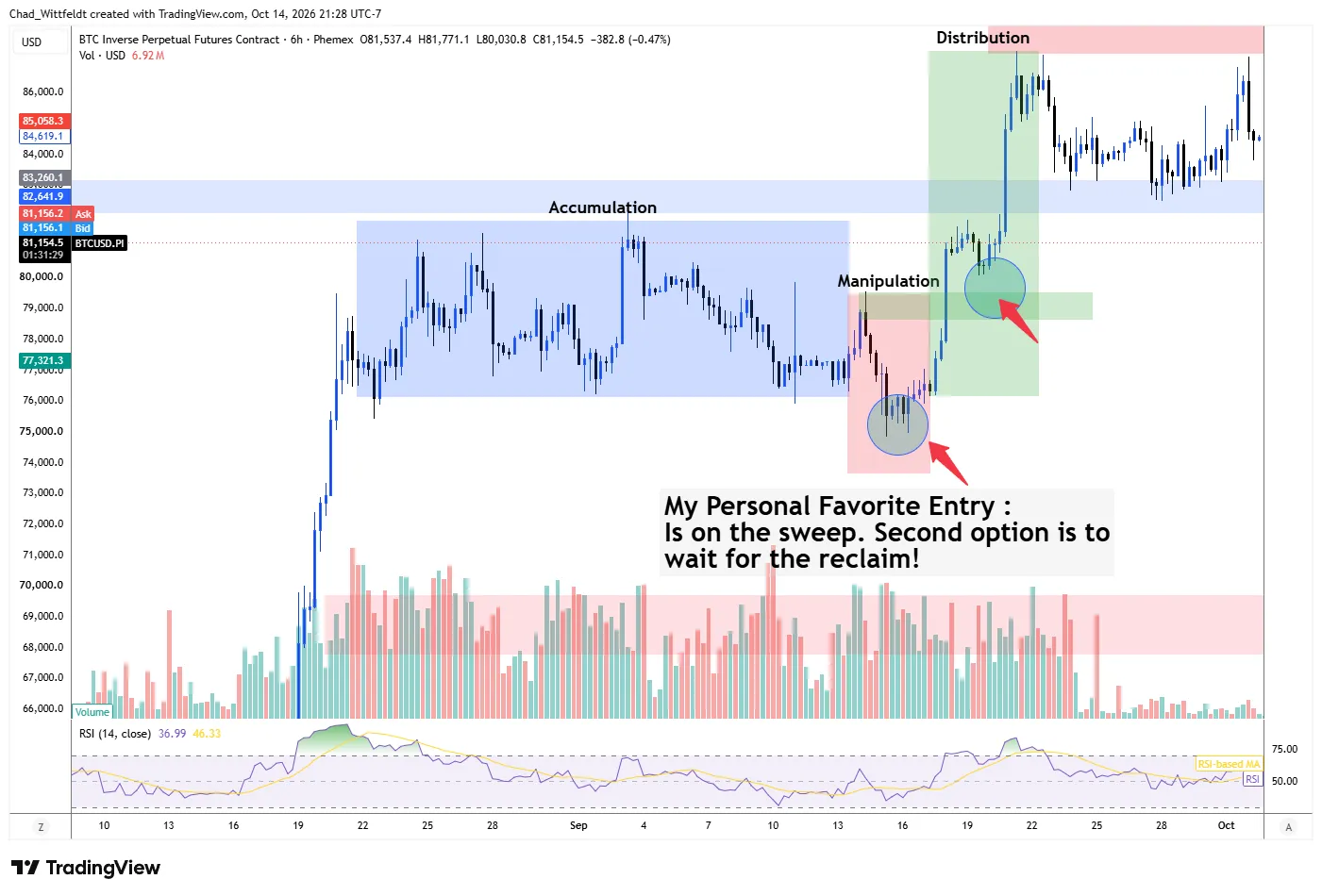
A sweep below the range low on my Bitcoin 6 hour chart, then the run higher. I walk through this same pattern in power of three trading.
The same thing happens upside down at resistance. Price breaks above an obvious high, pulls in the traders who chase the breakout, then fails and closes back below the level, taking out their stops on the way. We call that a fake out takeout: a break that fails and takes out the traders who chased it. Springs and fake out takeouts are the same mechanism from opposite sides of the range.
How far do sweeps run? In my own charting, sweeps below equal lows on the 1-hour and 4-hour charts have tended to run roughly 0.5% to 0.8% past the level. On the 5-minute chart, closer to 0.1% to 0.2%. Those are observations of how far sweeps go, not rules. Volatile sessions run deeper.
The difference between a sweep and a real breakdown is the close. A sweep closes back inside. A breakdown closes beyond the level, stays there and often retests it from the other side. Until the candle closes, you're guessing. "You don't really know until you know."
Why does the obvious stop always get taken in a stop hunt?
Because obvious is where the orders are. Think about how most people learn to place a stop. As I describe the standard advice in our sessions: "typically what you're gonna be taught is go, you gotta triple bottom, go long and put your stop loss right underneath, slightly under your previous low." Thousands of people learned the same rule, so thousands of stops sit in the same narrow band. The way I say it, "Everybody and their brother trading crypto who's done it for at least a month or two is going to have this support... This is why I set my limit order lower than this range."
And who's teaching everyone to put it right there? A thousand thumbnails with a red arrow under a triple bottom. Why? Because it looks clean on a thumbnail, and the sweep that follows never makes the video.
A sell stop loss is a resting order that becomes a market order once price reaches it. So a band of sell stops under equal lows is a band of market sell orders waiting for a trigger, right? Add leveraged longs whose liquidation prices sit nearby, and a small push can start a chain: stops trigger, selling speeds up, more stops trigger.
On the other side, anyone who wants to buy a large amount needs sellers. The deepest pool of sellers sits exactly where stops convert into market sells. Buyers absorb that supply, the selling runs out and price drifts back into the range.
None of that needs a conspiracy. It's crowded order flow doing what crowded order flow does. Blaming the market feels better, but it doesn't change your next trade. You can choose to be on the other side of it.
How do you trade the liquidity sweep instead of feeding it?
Let the level get taken, then enter. As I put it to members: the equal lows strategy "works really well, primarily because you're getting into the market where everybody else is getting stopped out of the market." Or, even shorter, I enter my trades where everybody else gets stopped out of their trades.
There are two ways to take it, and both are fine as long as you understand the difference:
- Catch the spring. Enter as the sweep happens and price starts to come back inside the range. Better entry, better risk to reward. "If you wanna catch the spring, you have to catch the spring now." The cost: if the spring falls out and never gets back into the range, the stop gets hit.
- Wait for the test. Let the sweep finish, let price reclaim the range and enter on the test that follows. "You're gonna give up a little bit of risk to reward for the sake of a higher probability."
You can also let the order do the waiting. A just in case order is a resting limit order placed where a liquidity grab would fill it, below the equal lows, so the sweep puts you in the trade while you're away from the screen. I like to stack two or three of them through the area where the sweep tends to reach, instead of trying to hit one exact price, with the total sized to the risk at the stop. What you never do is add contracts beyond your planned size as price falls. That doubles your risk.
The people selling at the bottom of the sweep are the liquidity for your entry. Be the one on the other side of them.
So where does your stop loss actually go?
Your stop goes where the trade is proven WRONG. On a long from equal lows, that's beyond the low of the sweep: if price takes that low out and doesn't come back, the setup has failed. "The stop-loss is the stop-loss is the stop-loss. You want to be setting stop-losses where it makes sense to no longer be in that trade based off your technical analysis."
There's no fixed buffer and no magic percentage. The chart sets the stop. What you control is the size, and that's the core of crypto risk management: the contract size comes from the distance to the stop, so the dollar risk stays the same whether the stop is close or far. See the invalidation level for how to find that price.
Position size = amount at risk ÷ distance from entry to stop
A worked example with equal lows
You have a $50,000 account and risk 1% per trade, which is $500. One percent is the risk unit we start new traders on, and closed trading data decides when it goes up. ETH has three distinct equal lows at $3,000 on the 4-hour chart. The range high sits near $3,400. The numbers are illustrative.
The crowd trade:
- Buys at $3,050 in front of the lows, stop at $2,990, just under them
- Distance: $60
- Size: $500 ÷ $60 = about 8.33 ETH
- A sweep to $2,976 takes the stop. The full $500 is gone, and price is back above $3,000 a candle later.
The sweep trade:
- Waits for the lows to be taken. Price wicks to $2,976, then closes back above $3,000
- Buys the reclaim at $3,010
- Stop beyond the sweep low, at $2,970: if price takes that out and stays below, the setup has failed
- Distance: $40
- Size: $500 ÷ $40 = 12.5 ETH
- Reward to $3,400 is $390 per ETH against $40 of risk, roughly 1 to 9.75
Same $500 at risk in both. The crowd trade is the liquidity. The sweep trade is the entry. If the sweep had run deeper, the stop would sit lower, the size would shrink and the dollar risk wouldn't change.
If the stop the chart gives you drags the target below 1 to 3, skip the trade. Don't move the stop until the numbers look prettier.
What can a liquidity sweep entry not save you from?
Entering after the sweep helps. It doesn't make you bulletproof.
- Some sweeps keep going. What looks like a spring can turn into a real breakdown. Price closes below and stays there. That's exactly the case your stop exists for.
- Some sweeps run deeper than the first one. A second sweep can take out the low you used. That's the cost of having a stop, and it's far smaller than the cost of not having one.
- Slippage. A stop order becomes a market order once triggered, so in a fast market the fill can land beyond your stop price. Weekend gaps and thin order books widen that.
- Leverage. Your liquidation price has to sit well beyond your stop. If it doesn't, the position can be closed before your plan is.
None of this is a reason to trade without stops or to keep them "in your head." It's a reason to place them where the trade breaks and size the position to match. At the end of the day, a mental stop is just a hope with a number on it.
What should you look at this week?
Pull up your last five stopped-out trades. For each one, mark whether you entered before the obvious level was taken or after. The pattern usually tells you more than the chart does.
Once you see it in your own trades, it gets a lot harder to keep volunteering as the liquidity.
If you want to practice entering after the sweep alongside people who trade it every week, join the Crypto Renegades Skool Community. It's free for a week, then $97/month. Try it free for a week.
This is education, not financial or investment advice.
Frequently asked questions
A stop hunt, or liquidity sweep, is a fast move through an obvious level where a crowd of stop orders sits. The move triggers those stops, which become market orders and fuel the push, then price often closes back inside the prior range. It doesn't need a rigged market, just crowded stops, and the sweep is usually a better entry than the level in front of it.
Most sweeps need no coordination. When many traders put stops at the same obvious level, triggered stops become market orders and fuel a fast move through it. Treat sweeps as predictable order flow to plan around.
Stop sitting in front of the sweep and use it as your entry. Wait for the obvious level to get taken, then enter when price comes back inside the range. The stop goes where the trade is proven wrong, usually beyond the low of the sweep, and the contract size comes from that distance so the dollar risk stays the same.
It varies with timeframe and volatility. In our charting, sweeps below equal lows on the 1-hour and 4-hour have tended to run roughly 0.5% to 0.8% past the level, and closer to 0.1% to 0.2% on the 5-minute. Treat those as observations of how far sweeps run, not as a rule for where to put a stop.
No. A tighter stop does not lower your risk if you size correctly, because the contract size adjusts to the stop. Put the stop where the trade is proven wrong and keep the dollar risk fixed. The stop is the stop.
Sources
General education only, not financial advice. Crypto and leverage involve substantial risk of loss. Read our risk disclosure.

Written by
Chad WittfeldtCo-Founder and Strategy Lead, Crypto Renegades
Chad first heard about Bitcoin in 2012, bought his first coin in 2013 at around $100, learned markets through forex in 2015 and went full time on crypto in 2017, posting public technical analysis on Bitcoin's break above $3,000 that August. That same year he flagged USI Tech and BitConnect as Ponzi schemes and warned the people around him before either one was exposed. He ran an Ethereum GPU mining operation from 2019 to 2021, and verification runs through everything he teaches.