HODL Is Not a Strategy. Here Is What Is
Buy and hold asks you to accept a 70% drawdown as the price of believing in the asset. Here's what that really costs, the HODL Paradox behind it, and what a plan for both directions looks like.

Updated
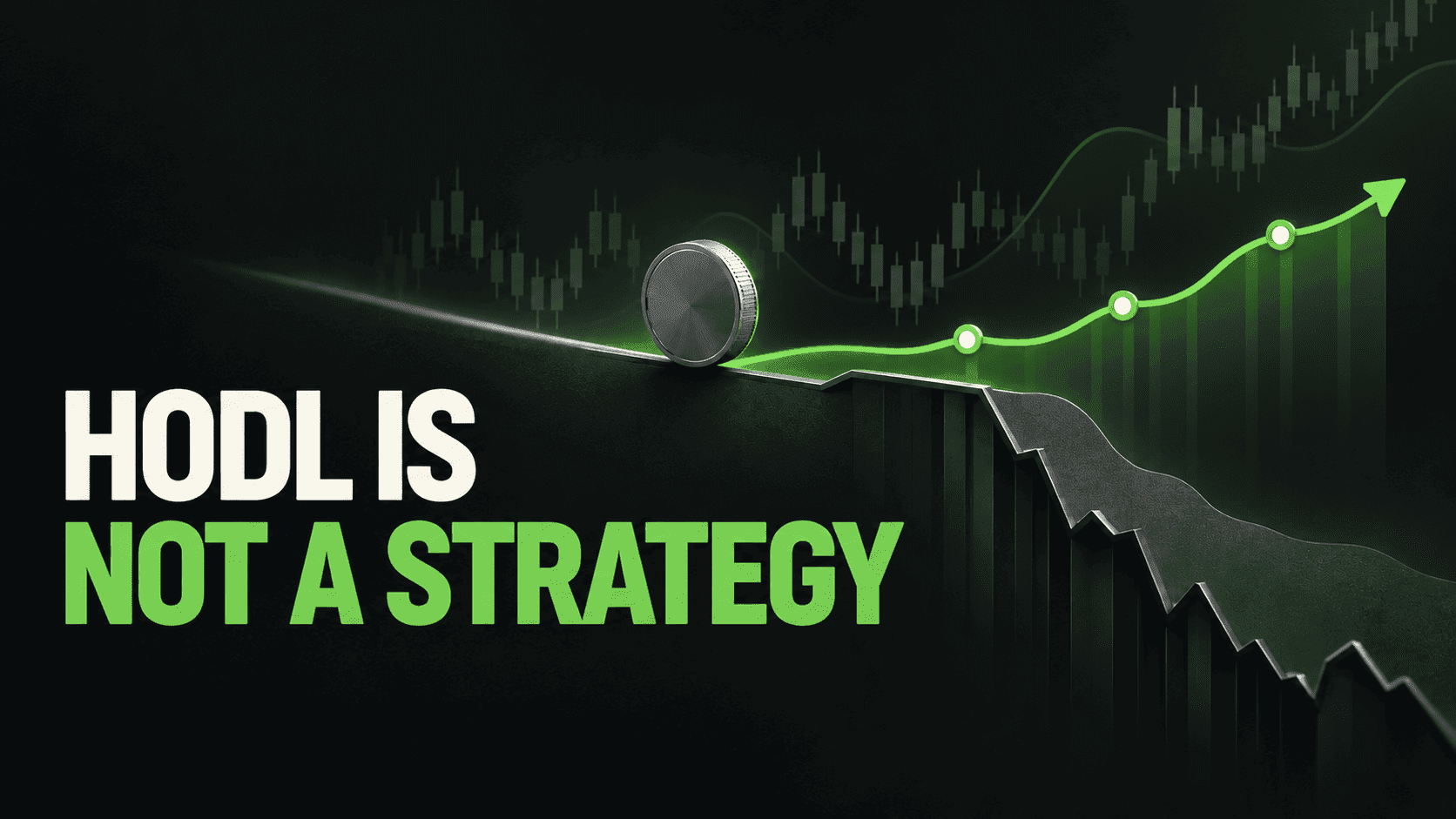
Holding on for dear life isn't a strategy. HODL is a coping mechanism with a catchy acronym.
HODL means buying a crypto asset and never selling, whatever the price does. It feels disciplined, and sometimes it works. But as a complete plan, it asks you to accept drawdowns like Bitcoin's 84% in 2018 and 77% in 2022 as the normal cost of believing in the asset, with no mechanism for anything other than waiting.
If you're just holding on, you're not in control. The market is.
So who is this for? If you're sitting on a bag right now and you're ready to own the decision, this is for you. If you'd rather blame the whales, the influencer and the exchange for your entry... I can't help with that. Nobody can.
How deep do crypto bear market drawdowns actually go?
Crypto bear markets go deeper than most people believe until they've lived through one.
Bitcoin fell about 84% from its peak in the 2018 bear market and about 77% in 2022 before recovering, as we lay out on the market cycles page. Many altcoins fell further and never came back. Anyone who has been in crypto for more than one cycle has lived through at least one of these declines.
I measured the legs on my own monthly chart. 427 days down from the 2017 high. About 1,000 days up. Then 395 days down from the 2021 high. Both bear legs ran more than a year.
Believing in the long-term thesis doesn't make the drawdown smaller. It just means you sit through every inch of it.
And price isn't the only way a holder gets hurt. When a major exchange collapsed in November 2022, nothing major happened to our members, because they already traded from self-custody. I'd been preaching "not your keys, not your crypto" long before that.
What does a 70% drawdown REALLY cost you?
The recovery math is brutal, and it isn't intuitive.
| Drawdown | $10,000 becomes | Gain needed to get back to $10,000 |
|---|---|---|
| 20% | $8,000 | 25% |
| 50% | $5,000 | 100% |
| 70% | $3,000 | 233% |
| 80% | $2,000 | 400% |
A 70% decline doesn't need a 70% rally to recover. It needs 233%. That's often years of waiting. And the rally that finally gets you back to even? It's the one where everyone else is buying.
There are costs beyond the number, too. Months of checking the price with no plan. Opportunities you can't take because your capital is frozen in a position you're afraid to touch. And the quiet regret of having no answer when someone asks, "What's your exit?"
That's not patience. That's paralysis wearing patience's clothes.
Why does buying near the top freeze HODLers solid?
Because most people who hold through a crash never planned to. They bought when the move was obvious and the headlines were loud, right near the top, and then the market turned. The story repeats every cycle: someone gets in right around the all-time high, and before they know it the market falls out from under them.
I call the setup behind this the HODL Paradox. People get pulled into crypto by the speed of the results they've heard about. Then they pick the slowest strategy in the market and measure it against those stories. As I put it in our portfolio course: "The expectations don't really meet the actions on that timeline." A real gain of thousands of dollars feels like a failure next to an imagined ten-x, and that gap is what pushes people toward the next shortcut.
The instinct is to blame the entry price. "I just got unlucky with timing." But was the entry really the problem? No. The problem was having no plan for either direction: no invalidation level, no drawdown limit, no way to act when the thesis stopped working. So doing nothing gets relabeled as patience.
I've lived the other side of this. I ran an Ethereum GPU mining operation from mid-2019 until late 2021. I was a late adopter, but I hit it hard. I read every Ethereum Improvement Proposal and every dev update myself, and I watched proof of stake work on the test networks. So in late 2021 I sold every rig, while most miners thought the switch would keep getting delayed. People thought I was crazy. The Merge went live on September 15, 2022, and that ended GPU mining on Ethereum.
That wasn't patience and it wasn't luck. I had a thesis, I tracked the evidence myself, and I acted on it instead of hoping.
At the end of the day, facts don't care about your feelings. And the chart doesn't care what you paid.
So what does a plan for both directions look like, instead of HODL?
A sailor who can only sail with the wind at their back is at the mercy of the weather. A sailor who knows how to tack makes progress whichever way it blows.
In markets, tacking is bidirectional exposure: being able to take positions in both directions with defined risk. In practice that can mean:
- Keeping long-term holdings, if you believe in them, as a defined part of the portfolio allocation rather than the whole of it.
- Hedging during downturns with short positions sized so that a falling market reduces the portfolio's losses rather than multiplying them.
- Taking active positions in either direction when a written thesis supports it, each with its own stop loss and position size.
Here's what I actually do near the top of a cycle. When I expect a cycle top, I rotate into stablecoins and I short on the way down. No formal hedge ratio. Just a plan for both directions.
Picture two farmers planting the same field. One plants only crops that need rain and prays for a wet year. The other plants a mix, some that thrive in rain and some in drought.
Same field, same weather, very different harvest.
Isn't shorting just gambling with extra steps?
Shorting used without rules? Yes. Shorting and leveraged contracts can lose money quickly, and liquidation can arrive faster than people expect. That risk is real, and anyone who tells you otherwise is selling something.
The real difference is undisciplined leverage versus leverage used inside a risk process. With a written thesis, a loss boundary set before entry, a position size built from that boundary, and a stop placed well before the liquidation price, a short position is a tool with a defined worst case. Without those, it's a bet.
That's why bidirectional exposure comes after risk management in everything we teach. Never before.
Holding a bag right now? Start here.
Start with the first steps of the Decision Protocol, the same seven decisions in the same order every time: thesis, invalidation level, position size, total exposure, entry and exit plan, journal, review.
- Write down your thesis for the position. Why do you still hold it? What would prove that reason wrong?
- Decide your worst case. At what price, or what portfolio drawdown, would you act instead of wait? That's your invalidation level.
- Check your total exposure. How much of your net worth is in positions that all move together? Capital in crypto should be unemotional risk capital: an amount you're comfortable learning with, that your month doesn't depend on. If a drawdown in the position changes how you sleep, the exposure is too large, whatever the chart says.
- Learn the other side before you use it. Study how short positions and hedges work, with small size or on paper, before real capital is involved.
None of this requires selling your long-term conviction. It requires having a plan that doesn't depend on the market doing what you hope.
So here's your job this week. Write down step 2 for every coin you hold. One number each. If you can't name it... that's the first thing to fix.
One number per coin, written down tonight, is the difference between holding a position and being held by one.
If you want to learn the full process, including how members plan for both directions, try the Crypto Renegades Skool Community free for a week.
This is education, not financial advice.
Frequently asked questions
Holding long-term positions can be a valid part of an allocation. The problem is treating it as the entire plan: no exit criteria, no drawdown limit and no way to benefit when the market falls. That leaves you entirely dependent on the market cooperating.
A 233% gain. After a 70% loss, $10,000 becomes $3,000, and $3,000 has to more than triple to get back to $10,000. The deeper the drawdown, the harder the recovery math becomes.
It means being able to take positions in both directions of the market, long and short, with defined risk. It turns a falling market from something you sit through into a condition you can plan for. It carries real risk and belongs after position sizing and loss boundaries are in place.
General education only, not financial advice. Crypto and leverage involve substantial risk of loss. Read our risk disclosure.

Written by
Chad WittfeldtCo-Founder and Strategy Lead, Crypto Renegades
Chad first heard about Bitcoin in 2012, bought his first coin in 2013 at around $100, learned markets through forex in 2015 and went full time on crypto in 2017, posting public technical analysis on Bitcoin's break above $3,000 that August. That same year he flagged USI Tech and BitConnect as Ponzi schemes and warned the people around him before either one was exposed. He ran an Ethereum GPU mining operation from 2019 to 2021, and verification runs through everything he teaches.